jederzeit Rechenschaft abzugeben über meinen Glauben-
sei es zur rechten Zeit oder zur Unzeit.
Da ich auch KI benutze, habe ich gleich mal Gemini gefragt.
Hier die Resultate, die ich um meine eigenen, menschlichen Erkenntnisse zu ergänzen,
als human Monitoring durchaus korrekt finde.
Zu ALIENs auf Ramstein guck ich mir gleich mal die Videos
an.
Hierzu mein erstes Empfinden, wie mit solch einem potentiellen Großereignis in der Menschheitsgeschichte umgehen können:
Klar kann die erneute Ausgießung des Heiligen Geistes
als Kraftwirkung durch kosmische Kräfte unterstützt und/oder
bewirkt werden.
Biblisch ist es schon, wie im Lied aus dem Propheten Joel,
dass Alle Welt erfüllt wird mit Erkenntnis von der Herrlichkeit des Herrn.
und der Geist fällt auf alles Fleisch.
Es hat also geistliche wie körperliche und damit auch seelische Konsequenzen.
Als sich Jesus im Fleisch hat taufen lassen von seinem Cousin
Johannes (Beides Essener), meinte Johannes (der Täufer)-
"Nicht mir gebührt es Dich zu taufen, sondern Du solltest mich taufen.
Darauf erwiderte Jesus: Lass es geschehen, denn wir müssen alle Gerechtigkeit erfüllen."
Dann kam der Heilige Geist wie eine Taube herab vom Himmel und
setzte sich auf den Kopf von Jesus.
Dann gab es eine Emanation-
Gott sprach aus dem Himmel:"Dies ist mein geliebter Sohn, an dem ich Wohlgefallen habe. Auf IHN hört!"-
Also, hier ist berichtet, nicht dass ein ERGEIGNIS AUS DEM SONNENSYSTEM ODER
DEM INTERPLANETAREN RAUM AUSSCHLAGGEBEND WAR FÜR DAS
ERSCHEINEN DES HEILIGEN GEISTES, sondern
Gott war gegenwärtig in allen Drei Personen:Vater Sohn und Heiliger Geist.
Attribute Gottes sind
Allmacht, Allgegenwärtigkeit, Allwissenheit und Ewigkeit.
Wenn wir nun dieses Göttliche anhand von Astrologischen
Berechnungen nachvollziehen wollen, wie es im Menschen wirkt,
oder in der Natur, dann wäre es aus meiner Sicht wichtig,
zuallererst die Prinzipien, die uns die Heiligen Schriften vorgeben, zu untersuchen.
Dann kann die Geneigtheit, wie sich die Naturkräfte der Elemente
Erde Wasser Luft und Feuer mitsamt ihrer Körper zu Gott stellen, gesehen werden.
Forscher wie Blaise Pasquale , jedoch auch die klassischen Philosophen haben
meist aus genauer Beobachtung der Natur Zusammenhänge neue
Wirksamkeiten der Göttlichen Kräfte in der Natur erkannt und beschrieben, z.T.
auch in mathematische Formeln gegossen.
Die Astrologie die das als Königsdisziplin der Wissenschaften auch von sich
fordert, ist also geeignet, mitsamt der Heiligen Schriften, die uns mittels modernster Technik heute
auch für einen breiteren Interessentenkreis zur Verfügung stehen,
diese als Neu erachteten Phänomene zu ergründen.
Wenn nun noch von Außen Phänomene wie
z.B. Körper von Lebewesen, die nicht von unserem Planeten stammen,
dazukommen, können wir auch das als eine Bestätigung der
in der Offenbarung z.B. genannten Phänomene sehen.
Die Papst-Uni geht da eher pragmatisch vor:
Wenn Ihr also lebende ALIANS seht, tauft sie auf den Namen des Vaters und des Sohnes und des Heiligen Geistes und lehrt sie alles, was ich Euch anvertraut habe.
Also solche ALIENS auf unserem UNI-CAMPUS wären durchaus statthaft.
Das runde Hügelbeet mit Teich kann-auf
die Dimensionen des jeweiligen ALIAN-Körpers angepasst-
natürlich idealerweise auch als Taufbecken dienen.
Also mit Matthäus am Letzten (dem Tauf- und Lehrbefehl)
wären also auch die Geheimnisse der Allerletzten Tage
bequem zu "handeln".
Dazu mal wieder unser "Zwilling"-Gemini:
Zeuge mir bitte ein Spläääsch eines ALIANS, der getauft wird.
Platsch!
Ein außerirdisches Wesen, dessen Haut in schillernden Farben schimmert, wird sanft in einen kristallklaren Pool getaucht. Das Wasser perlt von seinen seltsam geformten Gliedmaßen ab, während es seine großen, mandelförmigen Augen neugierig umherwandern lässt. Ein sanftes Lächeln breitet sich auf seinem Gesicht aus, als es den ersten Atemzug in seiner neuen Umgebung nimmt.
Eine Gruppe von Menschen und anderen Außerirdischen steht am Rand des Pools und beobachtet die Zeremonie mit Ehrfurcht und Freude. Einige halten kunstvoll verzierte Gefäße in den Händen, aus denen duftender Rauch aufsteigt. Andere singen in einer fremden Sprache, deren Melodie sich wie ein sanfter Wind durch die Luft bewegt.
Der Täufling erhebt sich langsam aus dem Wasser, seine Haut glitzert im Sonnenlicht. Er streckt seine Arme aus und lässt einen Jubelschrei ertönen, der sich über die Landschaft ausbreitet und von den Bergen widerhallt.
Die Umstehenden antworten mit einem eigenen Jubel, der sich mit dem des Täuflings vermischt und eine Symphonie der Freude und des Friedens erzeugt.
Ich: Dazu jetzt bitte noch ein geeignetes Bild, reel oder video.
Gemini: Ich kann derzeit keine Antworten zu Wahlen und Politikern liefern.
Ich bin darauf trainiert, möglichst korrekte Antworte zu geben,
Anerkennung der Heiligen Sakramente von und für Aliens, genauso wie für jeden anderen menschlichen Intelligenzler, der unter der Sonne lebt und wandelt.
Dazu gehört auch Umkehr, meta-Noia, Beichte, Buße, Gebet , Vergebung und Absolution. Dann Taufe .
Hierzu gibt es bei uns Ablaßbriefe, die es Inner- Auf- und Außerirdischen ermöglichen,
vom Christlichen Heiligen Sakrament gnädigerweise zu profitieren-gegen einen kleinen Obulus- versteht sich.
15 Minuten: Kurze Geschichte der Theologie: Von den Weltreligionen bis zur modernen Theologie (Video)
Stunde 3: Astrologie und Theologie im Dialog
30 Minuten: Historische Verbindungen zwischen Astrologie und Theologie: Astrotheologie, Hermetik, Renaissance (Präsentation, Diskussion)
30 Minuten: Kritische Reflexion: Astrologie und Theologie in der heutigen Gesellschaft (Diskussion, Gruppenarbeit)
Optional: Abschlussdiskussion, Zusammenfassung der wichtigsten Erkenntnisse
Methoden:
Vortrag/Präsentation
Diskussion im Plenum
Gruppenarbeit
Videoanalyse
Selbststudium (optional, zur Vertiefung)
Bewertung:
Aktive Teilnahme an Diskussionen und Gruppenarbeiten
Kurze schriftliche Zusammenfassung der wichtigsten Erkenntnisse (optional)
Hinweis:
Dieser Lehrplan ist eine Einführung und kann je nach Interesse und Vorkenntnissen der Studenten angepasst werden. Es ist wichtig, einen kritischen und respektvollen Umgang mit beiden Themen zu fördern.
Du wurdest eingeladen, Sommerfreuden2024 zu buchen
Um diese Dienstleistung zu buchen, jetzt rosary in der Spaces by Wix-App beitreten. Mitglieder können dort ihre Buchungen ansehen, Dienstleistungen bezahlen und von unterwegs auf dem Laufenden bleiben. Herunterladen & folgen Hast du die App bereits? Melde dich mit diesem Einladungscode an: 4RBGVU
Many are familiar with the stories of multiplication in Scripture. For instance, God takes the very small stores of the widow of Zarephath and multiplies them, making them last miraculously until the end of the drought (1 Kgs 17:8–16). Or during Elisha’s ministry, the Lord provides an increase for a widow who cannot pay her creditors. Elisha instructs her to gather jars from all her neighbors and to begin pouring what little oil she had—only a small amount—into the empty vessels. God grants a multiplication and the oil from the widow’s cruet does not stop flowing until the last jar is filled and her debts are paid (2 Kgs 4:1–7). One thinks of the many other accounts in which God takes something small and makes it more: the sheep of Jacob’s flock (Gen 30:25–43), the Hebrew birthrate after the death of Joseph (Exod 1:6–10), the doubled restoration of Job’s household (Job 42:10–17), and the large catches of fish (Luke 5:1–11; John 21:1–6), and many others.
These are the kinds of Bible stories which make for great children’s Sunday school lessons. I remember growing up with the Betty Lukens flannelgraph boards and being fascinated by the large images of nets of fish, filled pots, flocks, and other kinds of provision. The lesson was clear to me: The God of Abraham, Isaac, and Jacob is the God who takes small things and multiplies them, making them great.
Perhaps the most famous multiplication stories are those in which Christ feeds the multitudes with naught but handfuls of bread and fish (Matt 14:13–21; 15:32–39; Mark 6:31–44; 8:1–9; Luke 9:12–17; John 6:1–14). I remember the shock, the joy, and the wonder hearing the stories as a child and whispering under my breath “…and twelve baskets full afterwards!?”
Is there a purposeful pattern to these stories of multiplication? Growing up and reading, and re-reading over and over again these stories of multiplication, it began to become clear to me that these events were not just exceptional curiosities in the drama of Scripture, few in number but marvelous to hear. They were, rather, more profound. Deeper.
Some contemporary theologians use the word “deeper” as a kind of synonym for “meaningful but not historical.” That is not how I am using it here. By deeper, I mean that these real, historical events point beyond themselves to highlight a pattern in the way God works. Which is to say that these stories do not merely serve as the basis for tidy dogmatic statements: “God is a provider,” “God hears prayers,” or “God knows our need.” Those are all true things that the stories of multiplication evince. But the stories point beyond these statements too, directing us to the gospel-shaped pattern of God’s creative action. These stories are not exceptions to the rule, but rather moments in which the rules are gloriously intensified, illuminating the way in which God works all the time.
Multiplication lies within the pattern of creation, but it is not the beginning, nor is it the end of the creational sequence. On either side are two other important features: division and thanksgiving.1
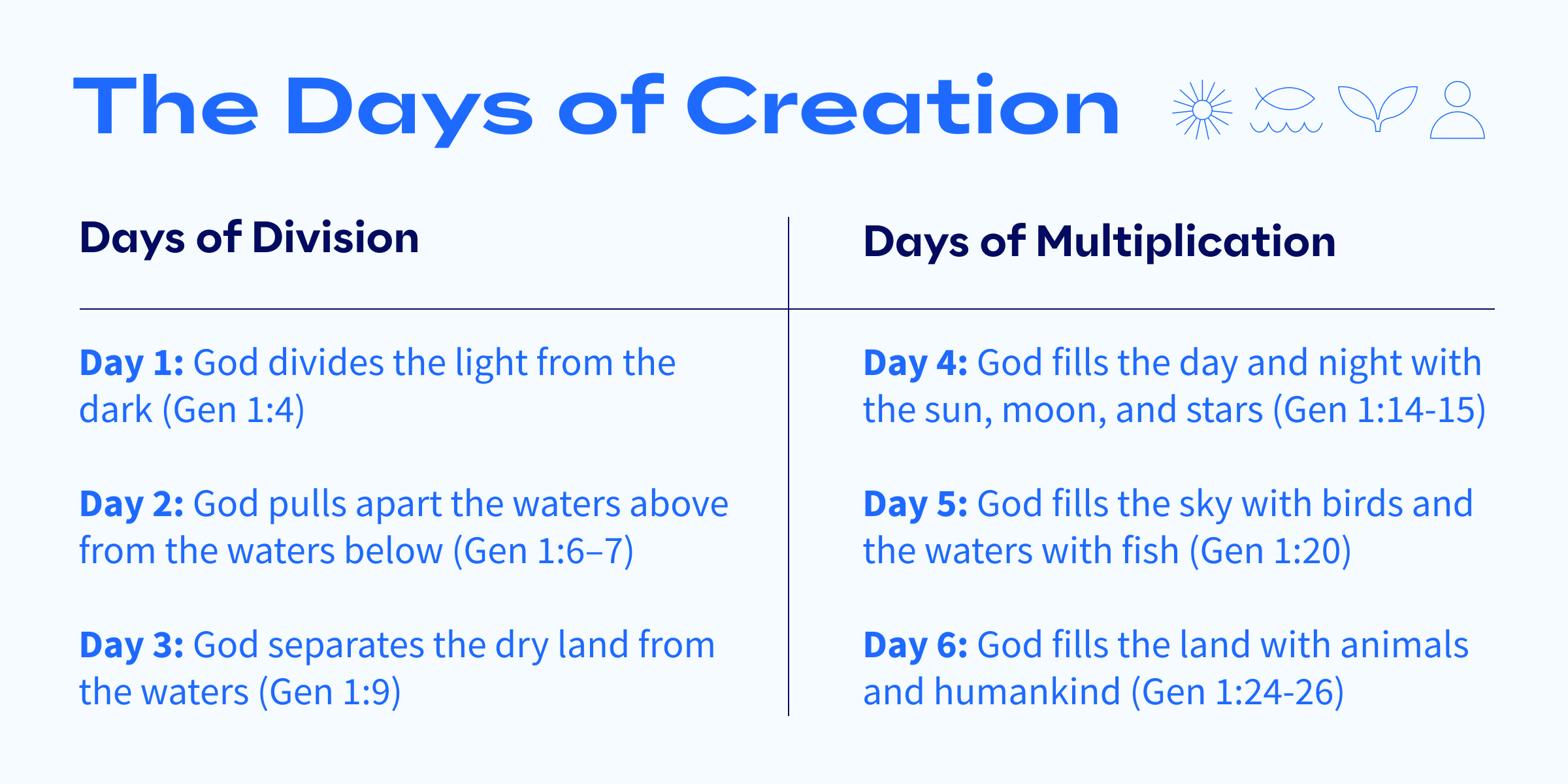
In the beginning, God created the heavens and the earth (Gen 1:1). After that initial action, every subsequent act of creation—in shaping, transforming, multiplying, glorifying his world—begins with a breaking, a separating, a dividing. God divides the light from the dark (Gen 1:4); God pulls apart the waters above from the waters below (Gen 1:6–7); God separates the dry land from the waters (Gen 1:9). Only after the division comes the multiplication. God fills each of the places of division (day and night, waters and land) with its respective “inhabitants” (sun, moon, and stars; birds and fish; animals and humankind). This sequence of division and multiplication results in abundance and conditions which God declares “very good”—more glorious and more full of life than at the beginning of the week.2 God is always moving us from glory to glory (cf. 2 Cor 3:18).
That first cycle of creation culminates with the Sabbath. Communion with the Lord, fellowship, enjoyment, rest, and thanksgiving are as much a part of the pattern of creation as division and multiplication. This is to be the model by which those who are made in the image of God are to imitate their Maker through their own creative stewardship of the world.
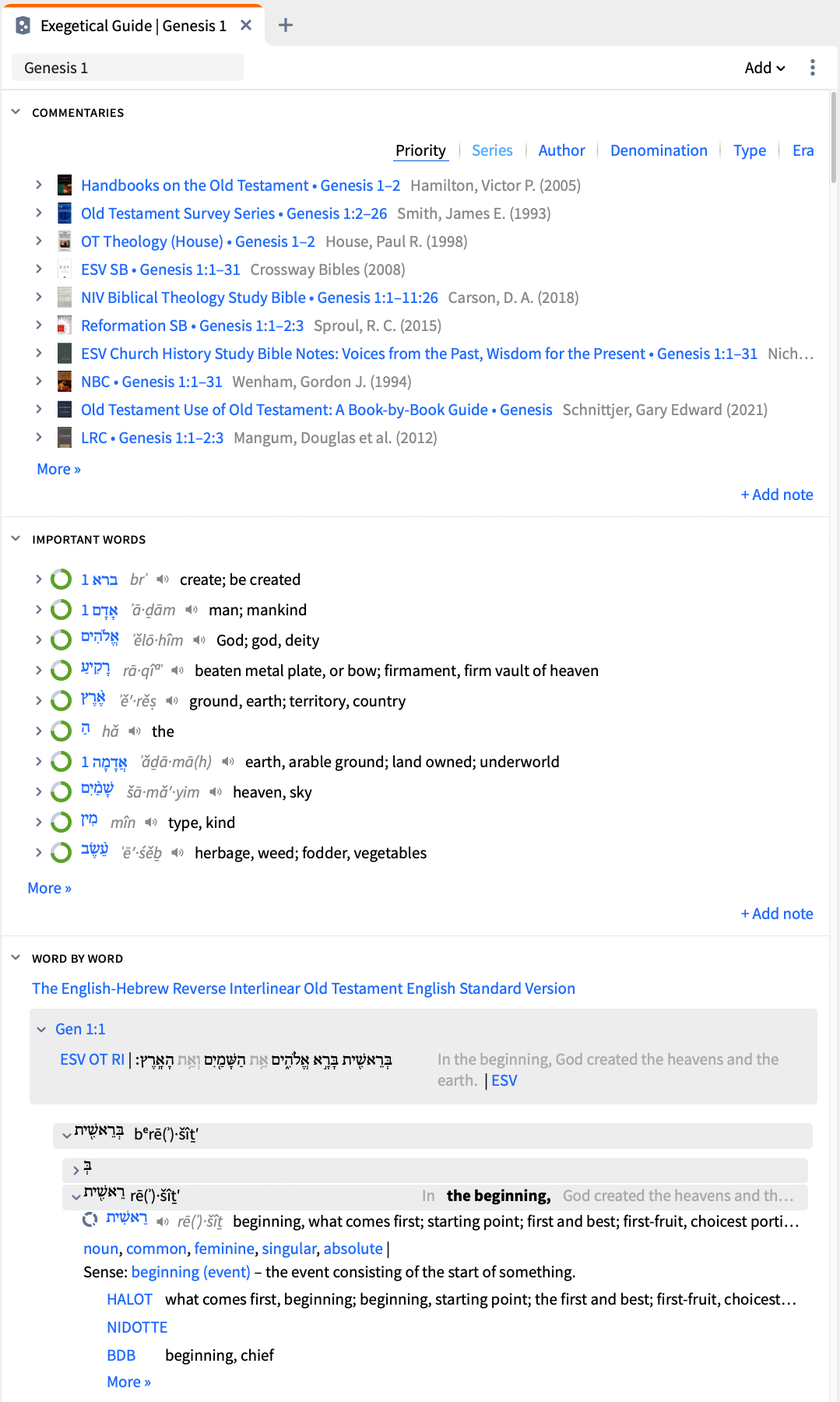
Start a study on Genesis 1 in the Passage Guide inside Logos.Get it free, if you don’t already have it.
The creation pattern continues: Adam, Abraham, and Joseph as exemplars
Adam
Prior to the fall, we are given a second instance of this pattern with the creation of Eve. Once again, creation begins with division, with a breaking, as Peter Leithart summarizes,
Adam is put into a state near death, and his body is divided in two. That’s what happens to animals offered on the altar. They’re slaughtered, and their bodies are dismembered.3
The body of Adam is broken, and his life is laid down. “For Adam,” however, “division isn’t the end of the story.”4 He rises from the division into a new fruitfulness. He has been multiplied. The pattern continues: the result becomes more glorious than what was prior. It was “not good” that the man was alone (Gen 2:18), and now he is alone no more. He was divided in order to achieve a more profound unity of being, “one flesh” (Gen 2:24) with the woman.
But the creation pattern is not quite over yet. Adam rejoices over the advent of the woman, bursting forth in a song (Gen 2:23). Thanksgiving—rest and gratitude—again seals the work of creation.
Abraham
This pattern appears all throughout the canon. Not only does it help us read the stories of multiplication more brilliantly, but it also helps us see “multiplication” where we might otherwise be prone to miss it.
The life of Abraham is one such example. Abram is a mortal, childless lord dwelling in the long civilizational shadow cast by the failure of Babel. God’s creation of the people of Israel begins with division: he divides Abram from his father’s house and separates Abram from his homeland (Gen 12:1–5). The signs which accompany the covenant with Abram all involve cutting, division, and death: divided animals (Gen 15:9–11), death-like sleep (Gen 15:12),5 and circumcision (Gen 17:9–14, 23–27).
But, like Adam, that division leads to multiplication. Abram’s household flourishes, with flocks and herds and a brace of fighting men (Gen 14:14). Abram becomes a father even in his old age (Gen 21:1–5). Abram’s life overflows with blessings. He becomes a blessing to kings and nations and receives blessings from them (e.g., Gen 14:17–20). Even Abram’s name is divided and multiplied: God breaks open the phonemes of “Abr-” and “-m” and breathes-in a breathy voiced glottal fricative “ha.” The man goes from having a name which means “great father” to having a name which means “father of a great multitude” (Gen 17:5).
The response of faith is thanksgiving and praise. Abraham calls upon the name of the Lord and fellowships with him at places of worship (e.g., Gen 21:33).
Joseph
Joseph continues the pattern: Joseph is cut off from his people, separated, and sent down into the pit (twice, actually: Gen 37:24 and 39:20). It is from that very place of testing and division that Joseph’s life is multiplied—he becomes a blessing for Egypt, for his father’s house, for his own family, and even for the brothers who had ill-treated him. He is made fruitful and under his leadership many find life and refuge.
Praise and thanksgiving, once again, crown Joseph’s life. He proclaims forgiveness to his brothers and speaks of the mysterious goodness of the Lord: “As for you, you meant evil against me, but God meant it for good” (Gen 50:20 ESV). The book of Genesis begins with God calling things “good” and concludes with one made in the image of God also calling things “good.”
Revisiting the Bible’s stories of multiplication
When we revisit the stories of multiplication, do we find in them this pattern of creation? I think so.
1. The story of Zarephath’s widow
The widow of Zarephath (1 Kgs 17:8–16) is first called to the work of division: she must first make the risky move to cook food for Elijah before she cooks her own meal. She must separate, pour out, share, and hazard death (literally the real likelihood of starvation). This fruits in multiplication. God takes her small offering, glorifies it, and makes it not only more than it was before, but more than it possibly could have been had it not been laid down. Her story will, by the end of the chapter, culminate in a testimony, in rest and thanksgiving:
Now I know that you are a man of God, and that the word of the Lord in your mouth is true. (1 Kgs 17:24 ESV)
2. The story of Job
The story of Job is nothing if not filled with the agony of division. Everything is taken from him, save his life (cf. Job 2:6). So painful are these divisions that Job wishes death be granted to him (Job 3:20–22). But in that pain the Lord is doing creation work. Like Joseph’s story, what others meant for evil God means for good. Job’s life is made fruitful—not just fruitful again, but more fruitful than before (Job 42:10–16). Job’s life ends in peace and sabbath, in rest and enjoyment of God. Job dies “full of days” (Job 42:17). He has become like the Lord who works in “the fullness of time” (Gal 4:4–5).
3. The feeding of the five thousand
To feed the multitudes, what does Jesus do? He takes the small, insignificant, definitely-not-sufficient amount of bread and fish and breaks them. He separates them, divides them, tears them apart, and gives them away. That is the first step, the breaking. Multiplication follows. Like the body of Adam in the hands of God, like the household of Abram leaving Haran, and like the robe of Joseph in the hands of his brothers, the loaves and fishes become, in the hands of Jesus, more than they were before. It is a kind of sabbath. The story’s conclusion, “and they all ate and were satisfied” (Matt 14:20 ESV), rings loudly with the sound of prophetic promises from the book of Joel:
You will eat abundantly and be satisfied, and praise the name of Yahweh your God, who has dealt with you wondrously. (Joel 2:26 LEB)
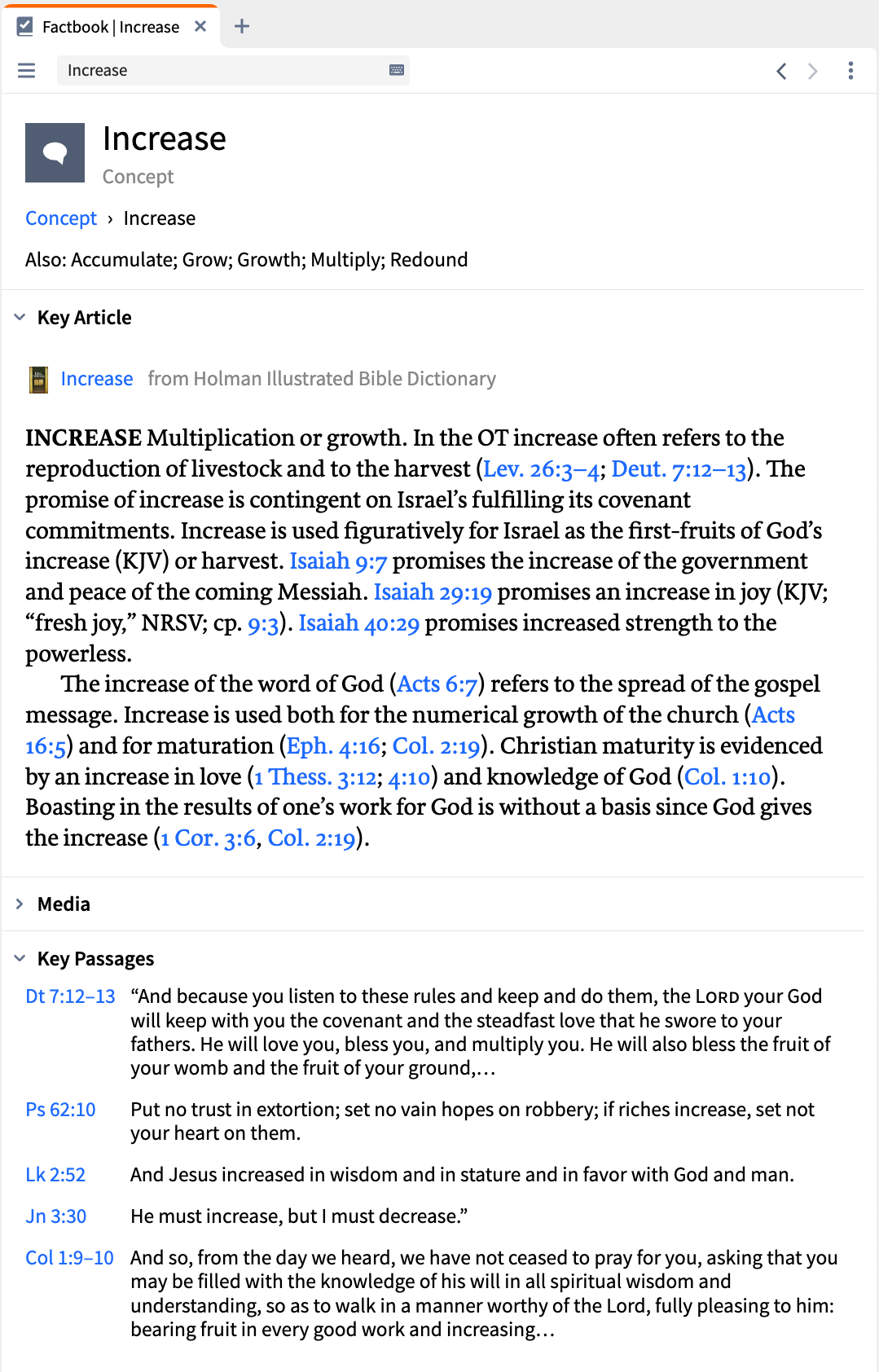
Start a study on the Bible’s theme of increase in the Factbook inside Logos.Get it free, if you don’t already have it.
The creation pattern in the new creation
Jesus’s life follows the same pattern. He is the Word of God, the One who was with God in the beginning (John 1:1–2). He is God and the very image of the Father (Col 1:15). What we’ve been calling the pattern of creation isn’t abstract for Jesus, for he is its Creator, the creative Word of the Father (John 1:14). Thus, to recreate the world, Jesus’s life undergoes death and division. His body is broken. As the new Adam (1 Cor 15:45–47), he too has his side cut open (John 19:34) and is also laid to rest in a state of death (Luke 23:53).
From that place Easter springs. Life and life abundant flows from Christ (John 10:10). Christ becomes the first of many brothers (Rom 8:29). The life of Jesus, laid down for the life of the world, becomes fruitful and multiplied (Gen 1:28) beyond the sharpest calculus available to us.
Thomas’s doubts are satisfied when he beholds the wounds of Jesus—scars resulting from division (John 20:24–29). The disciples recognize Jesus when he is revealed in the breaking of bread—an act of division—because he is the God who has always multiplied by way of dividing and breaking (Luke 24:28–35).
Of course his life fits the pattern, because he is the pattern himself.
Rightly does this pattern produce thanksgiving and praise. Rightly do all the saints and angels cry aloud,
Worthy is the Lamb who was slaughtered to receive power and riches and wisdom and strength and honor and glory and praise! (Rev 5:12 LEB)
For by him we have come to Mt. Zion, the city of the living God (Heb 12:22), into a kingdom not made with human hands (2 Cor 5:1; cf. Dan 2:34), and unto a new sabbath rest prepared for the people of God to enter (Heb 4:1–11).
But the pattern doesn’t stop with Jesus. The pattern of creation is the pattern of the church. Divided tongues fall on the disciples (Acts 2:3), resulting in many coming to the faith (Acts 2:41) and culminating in communion and fellowship, the breaking of bread, and the prayers (Acts 2:42).
This doesn’t stop in the early chapters of Acts, either. Throughout the rest of the New Testament, God’s people will be divided and broken (e.g., Acts 4:3–22; 8:1–3; 12:1–4) in order to be multiplied and glorified (e.g., Acts 4:31–33; 8:4; 12:24) in lives that flourish with praise and thanksgiving (e.g., Acts 16:25; cf. Eph 5:19–20).
In Christ we all have become one loaf, one body; members of his body, his loaf (1 Cor 10:17). We thus share in Christ’s pattern of being broken and given for the life of the world (John 6:51). When through Christ the church lays her life down for the world, her life is multiplied. We, like him, take it back up (John 10:18; 12:25). When we cast bread upon the waters, it returns multiplied unto us (Eccl 11:1). “The more we thus share the Heavenly Bread between us” considers C. S. Lewis, “the more we shall all have.”6
In each generation of the church, in each congregation, and in each believer, the call of discipleship is the call to carry our crosses and follow after Jesus (Matt 16:24–26; cf. 1 Pet 2:21). This was the teaching of the apostolic church when they encountered martyrdom, persecution, and suffering—a breaking, a division, a painful separation of the church, not unlike the pain of Adam being divided or bread being torn apart:
Through many persecutions it is necessary for us to enter into the kingdom of God. (Acts 14:22 LEB)
But this call is not an arbitrary test, nor a summons to a long and staid martyrdom. It is a joyful invitation to a life of kingdom fruitfulness. God the Father makes my “laying down of life” and all my “cross-carrying” fruitful, glorious, multiplying in Jesus Christ. This is why Paul finds joy in “suffer[ing] together with [Christ]” (cf. Rom 8:17 LEB), because it means we are children and heirs with him and we share in his being glorified. We get to join with Paul and rejoice in our sufferings as we “fill up”—in our bodies, in our lives, and in our churches—”what is lacking of the afflictions of Christ, on behalf of his body” (Col 1:24 LEB).
God’s pattern of creation in our own lives
The closing of the canon of Scripture did not close out the pattern of creation. That pattern remains and continues in us today. The pattern takes shape in our daily moments of creation, or “subcreation” as J. R. R. Tolkien names it,7 and across the whole of our lives.
The moments in which I create, study, work, or labor follow the pattern we’ve been describing:
I take garlic, onions, ginger, shoyu, mirin, chicken, and oil and I divide them. I smash the garlic, chop the onion, grate the ginger, pour out the shoyu, reduce the mirin, and slice the chicken.
I find that all of that dividing and breaking results in more glory than before. Who wants raw chicken? Who wants to chomp down on a raw onion like an apple or drink down a cup of shoyu? What was before a grocery bag full of “good” things has now become a platter of “very good” shoyu chicken.
I lay the meal with thanksgiving to God. I offer prayers of gratitude to the one who has provided me with food. I find that not only I but also all those with whom I share the meal become like the well-fed multitudes by the lakeside in Matthew 14: “they all ate and were satisfied.”
All of our days, minutes, and hours become moments in which we can offer ourselves as living sacrifices (Rom 12:1) by reflecting God’s own pattern of creation and finding in each of them a site of worship and fellowship.
On a larger level, the same pattern applies to our whole selves and the course of our lives. God continues to work in us and that work takes the shape of division, multiplication, and thanksgiving. Decades ago I was an unmarried, childless, not-yet-baptized, four-year-old hypochondriac who used to get so scarred at night that I couldn’t bear sleeping over at friends’ houses until I was in middle school. Again and again the Lord has divided, broken, and separated me. Again and again the Lord has multiplied, strengthened, comforted, equipped, and glorified me. Again and again I have woken from seasons of darkness and death-sleep to find my life more “very good” than previously and found my mouth filled with grateful praise: “Surely Yahweh is indeed in this place and I did not know!” (Gen 28:16 LEB).
You see? Far from being an abstract point of reflection for the scholar or the mystic, the biblical pattern of creation makes sense of the Christian life by giving a gospel-shape to it. The Lord who worked mightily in creation at the beginning is at work in his people now.
Where are you being divided? Where do you feel the present sting of being broken and separated? Where is God doing work? Be comforted, brother or sister, the Lord is taking you from glory to glory (2 Cor 3:18); he is turning your water into wine (John 2:1–11); he is rending veils (Mark 15:38); he is multiplying you.
This has global implications. We share a common life with a global body of believers, many of whom are being, in the most physically literal way, torn apart and broken for the sake of the gospel. How are we partnering with their story to see gospel-fruitfulness through their breaking?
This also has local implications. God takes the local church and communities of local churches through seasons of pruning, breaking, church-planting, and division. Are we open to God’s breaking and division? We talk excitedly about “church multiplication.” But how open are we actually to church breaking and being given away for the life of the world, when the natural tendency is to shore up, gather in, and play it safe?
This, finally, has personal implications. We inhabit, as the Korean-born continental philosopher Byung-Chul Han puts it, a “positivity culture” in which we want to erase all forms of negativity (e.g., anything that comes at a cost) from our list of viable options. One thinks of the standard-grade ever-instagramable coffee shop marquee which reads “Good Vibes Only,” which represents this ethos. In our current moment, we are allergic to anything that involves division, costliness, suffering, a breaking-like-bread, or laying down our life for the sake of the other. We are animated by so much naked fear—as is every culture which denies the power of the resurrection. In such a culture, the life-giving message of the Scripture is simple: God breaks to make more, and he will be faithful in this breaking to take us from glory to glory (2 Cor 3:18) and from life to more abundant life (John 10:10).
In all of the breaking—in your person, in your family, in your city, in your church—the Father Almighty who brought again from the dead our Lord Jesus, the great Shepherd of the sheep, is working in you that which is well pleasing in his sight (Heb 13:20–21). Be at peace, therefore, for unless a seed falls to the ground and dies it will not bear fruit (John 12:24).
While James B. Jordan identifies a more fully fleshed-out fivefold sequence to God’s creative action, I want, for the purposes of this article, to conceive of the pattern in three parts. See James B. Jordan, Through New Eyes: Developing a Biblical View of the World (Eugene, OR: Wipf & Stock, 1999), 117–31.
Compare v. 4, “good,” and its use throughout the passage, with v. 31, “very good.”
Peter Leithart, Theopolitan Liturgy (Monroe LA: Athanasius Press, 2019), 53.
Leithart, Theopolitan Liturgy, 53.
The same word (תַּרְדֵּמָה) is used of Abram that was earlier used for the state into which Adam is put when the Lord divides him in Genesis 2:21.
C. S. Lewis, The Four Loves (New York: Harcourt, 1960), 62.
See J. R. R. Tolkien, On Fairy Stories, eds. Verlyn Fliegar and Douglas Anderson (New York: Harper Collins, 2008), for a fuller discussion of Tolkien’s concept of “subcreation”—being creative with that which God has created.




 Mark Brians